

Blade 101: Confidence-Building Tips for the First-Time Knife Owner
Becoming a first-time knife owner involves more than just buying a tool; it requires learning the physical mechanics of safe handling. You should start by browsing pocket knives online to find a handle size that fits your palm comfortably. Understanding the basic physics of cutting reduces the risk of accidents and builds your confidence quickly.
Learning how to control the direction of the blade and the tension in your hand is the first step toward mastery. By following established safety rules, you ensure that every interaction with your tool is predictable and safe. This knowledge allows you to focus on the utility and craftsmanship of your blade without unnecessary fear.
Safe Cutting Directions and the Blood Circle
The most basic rule you must follow is always cutting away from your body and away from any other person nearby. You should establish what is known as a “blood circle” by extending your arm with the closed knife to ensure no one is within reach of the blade. This physical space acts as a buffer zone so that if the blade slips, it continues into empty air rather than your own limbs.
You should always position your material so that the stroke of the knife moves in a direction where a slip will not strike your legs or torso. This requires you to be conscious of your surroundings and your body position before you ever apply pressure to the edge. Maintaining this spatial awareness is the primary way to prevent deep lacerations during daily tasks.
Proper Grip and Hand Positioning
When handling a large fixed blade, your grip must be firm and consistent to maintain control over the weight of the steel. You should wrap your fingers completely around the handle, ensuring your index finger is protected by the guard. A secure grip prevents the knife from twisting in your hand when you hit a knot in wood or a tough material.
You must never place your thumb on the spine of the blade unless the knife is specifically designed with jimping for that purpose. Placing your thumb in the wrong spot can lead to your hand slipping forward onto the sharp edge if the knife hits an unexpected obstruction. This steady approach ensures you can use the full leverage of the tool without compromising your safety.
Safely Testing the Sharpness of a New Edge
Testing a blade by running your thumb along the edge is a dangerous habit that you should avoid entirely. Instead, you can test the sharpness of your steel by using a single sheet of printer paper held vertically. A sharp blade will slice through the paper with almost no resistance or tearing, indicating the edge is uniform and clean.
If you do not have paper, you can look at the edge under a bright light to see if any part of the steel reflects light back at you. A perfectly sharp edge is so thin that it does not reflect light; if you see bright glints, it means the edge is rolled or dull in those spots. These non-contact methods keep your skin safe while providing an accurate assessment of the blade’s condition.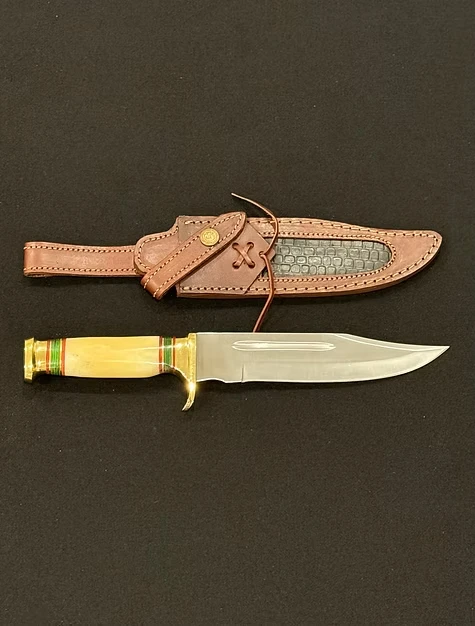
Building Your Skills and Collection
Developing these habits will make you a more capable owner and allow you to appreciate the fine details of your tools. Whether you are using a utility folder or showing off gun decor in your home, safety remains the foundation of your hobby.
You can find many pocket knives online that offer both high-level performance and beautiful aesthetic finishes for your kit. If you are looking for a unique piece to start your collection, consider a custom Damascus knife that combines ancient forging techniques with modern reliability.
Visit Gun Decor Emporium to see a full selection of premium blades and accessories designed for those who value quality and tradition.
Contact us to find out more.